
ANALYSIS OF REQUIREMENTS TO THE METHOD OF LAUNCH OF ANTI-SHIP MISSILES DEFINED BY THE SPECIFICITY OF MODERN MARINE WEAPONS AND STRATEGIES FOR THE COMBAT USE OF THE NAVY
- Authors
-
-
Igor Zvershkhovskyi
State Enterprise "State Design Bureau "Luch""
-
-
-
Danylo Zinchenko
National Technical University of Ukraine «Igor Sikorsky Kyiv Polytechnic Institute»
-
- Keywords:
- choice of launch method for anti-ship missiles, limitations due to the level of thrust-to-weight ratio of the missile, requirements for firing targets on the near border, initial stages of development of vertical launch launchers
- Abstract
-
The article shows that the specific features of the combat application of anti-ship missile systems require, when choosing the method of missile launch, taking into account the limitations caused by the level of thrust-to-weight ratio of the missile, requirements for firing at targets on the short range, increasing requirements for missile reliability during its long-term storage and operation in the field conditions. Satisfaction of the specified requirements for anti-ship missile complexes is most fully achieved by application of vertical gas-dynamic method of missile launch with forced declination of the missile on the trajectory of the required movement.
The use of vertical gas-dynamic container launch of anti-ship missiles of coastal missile systems makes it necessary to address the optimal choice of mass and energy characteristics of the «container-missile» subsystem.
The presented approach can be used at the initial stages of development of launch units of missile systems vertical launch to solve the issues of selecting the optimal design of the subsystem «container-missile» and launch units as a whole.
- Author Biographies
- References
-
Zvershkhovsky, I.V., Kanishchev, V.V., Katsan, A.M. & Kuchinskaya, O.B. (2021). Against ship complexes − effective armament of coastal units and ships of the fleet. Weapons and military equipment. № 2(30). Pp. 60—66.
Lapitsky, S.V. & Chepkov, I.B. Fundamentals of military-technical research. Theory and applications : monograph : in 4 vol. Vol. 4. Methodology of research of complex military systems; ed. by S.V. Lapitsky. K.: Dmitriy Burago Publ. House, 2013. 480 р.
Ayupov, V.V. (2017). Mathematical modeling of technical systems. Tutorial. Perm «Prokrost». Pp. 11—17.
Zvershkhovsky, I.V., Zirka, M.V., Petushkov, V.V. & Kuchinska, O.B. (2021). The problem of block synthesis of missile preparation and start-up control system for missile complexes. K.: Weapons and military equipment. No. 3(31). Pp. 21—33. DOI: https://doi.org/10.34169/2414-0651.2021.3(31).21-33
Coll. of works Leningrad Mechanical Inst. 1961. No. 17.
Combat properties of nuclear weapons. M.: Military Publ. House. І967.
Chepurnov, I.A., Serov, S.A. & Vorotnyuk, Yu.S. (2012). ABM systems, theoretical foundations of radar, principles of construction of complexes: M.: Publ. house of Bauman Moscow State Technical Univ.
Reliability in engineering. Terms and Definitions. State Standard 133−75.
Olenovich, I.F., Safiulin, Kh. & Svechnikov, V.V. (1974). Research report 26−53. P. VII. KVAIU. DOI: https://doi.org/10.1680/macr.1974.26.86.53-1
Olenovich, I.F., Safiulin, Kh. & Golovin, A.A. (1975). Research report No. FU-4-70. P. IX. Air Defense Branch of the Ground Forces VAOLKA.
Safiulin, X. & Olenovich, I.F. (1974). On the issue of assessing the quality level of launchers in the prelaunch period. M. Iss. 9(96).
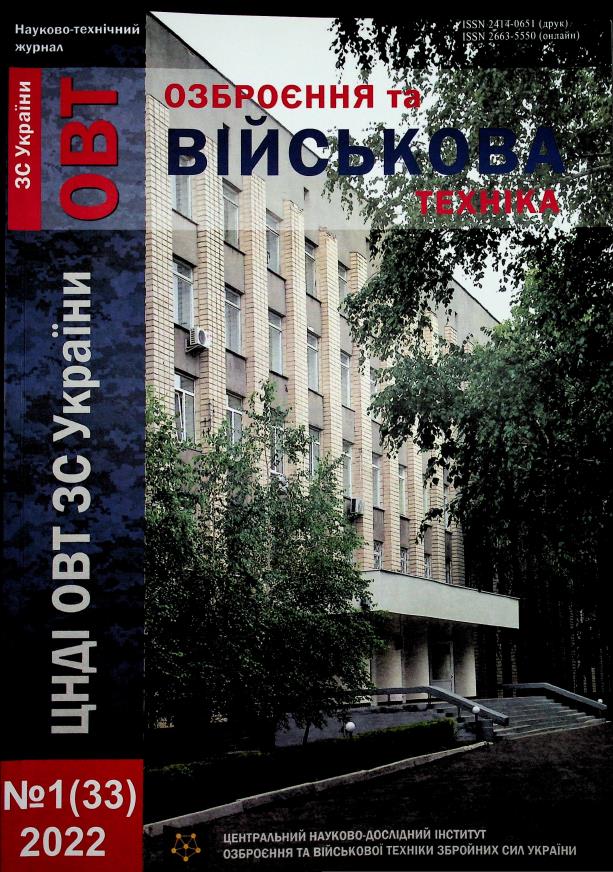
- Cover Image
-
- Downloads
- Published
- 2022-03-31
- Section
- MISSILES COMPLEXES
- License
-
Copyright (c) 2022 Ігор Звершховський,Марія Зірка,Оксана Кучинська ,Данило Зінченко

This work is licensed under a Creative Commons Attribution 4.0 International License.

How to Cite
Most read articles by the same author(s)
- Igor Zvershkhovskyi, Vadim Kanischev, Andrey Katsan, Oksana Kuchynska, Oleksii Kozachenko, Anti-ship complexes – effective weapons of coastal units and fleet ships , Weapons and military equipment: Vol. 30 No. 2 (2021): Weapons and military equipment
- Igor Zvershkhovskyi, Mariya Zirka, Volodymyr Petushkov, Oksana Kuchynska, The problem of block synthesis of missile preparation and start-up control system for missile complexes , Weapons and military equipment: Vol. 31 No. 3 (2021): Weapons and military equipment
- Igor Zvershkhovskyi, Mariya Zirka, Volodymyr Petushkov, Oksana Kuchynska, Reliability model of preparation and start-up control system for missile complexes , Weapons and military equipment: Vol. 32 No. 4 (2021): Weapons and military equipment
- Anatolii Hurnovych, Sergiy Lapitsky, Oksana Kuchynska, Conceptual views on the technical appearance of individual small arms of the armed forces of Ukraine , Weapons and military equipment: Vol. 41 No. 1 (2024): Weapons and military equipment
- Igor Zvershkhovskyi, Mariya Zirka , Volodymyr Petushkov , Oksana Kuchynska , TECHNOLOGICAL ASPECTS OF THE CONSTRUCTION OF MISSILE CONTROL SYSTEMS WITH A COORDINATOR OPERATING IN THE RADAR RANGE , Weapons and military equipment: Vol. 34 No. 2 (2022): Weapons and military equipment
- Igor Zvershkhovskyi , Mariya Zirka , Oksana Kuchynska , GENERALIZED ALGORITHM FOR STUDYING THE INFLUENCE OF TECHNICAL AND OPERATIONAL CHARACTERISTICS OF LAUNCHING SYSTEMS ON THE EFFICIENCY OF THE MISSILE COMPLEX , Weapons and military equipment: Vol. 38 No. 2 (2023): Weapons and military equipment
- Igor Zvershkhovskyi , Марія Зірка, Oksana Kuchynska , METHODOLOGY FOR OPTIMIZING THE PARAMETERS OF THE «CONTAINER-MISSILE» SUBSYSTEM , Weapons and military equipment: Vol. 35 No. 3 (2022): Weapons and military equipment
- Igor Zvershkhovskyi , Mariya Zirka , Oksana Kuchynska , TECHNOLOGICAL ASPECTS OF CONSTRUCTING A MISSILE'S CONTROL SYSTEM WITH COMPLEXING COORDINATORS IN THE PRESENCE OF FUNCTIONAL CONNECTION BETWEEN THEM AND MUTUAL CORRECTION , Weapons and military equipment: Vol. 36 No. 4 (2022): Weapons and military equipment
- Anatolii Hurnovych, Serhii Lapytskyi, Oksana Kuchynska, Svitlana Sai, Methodological approach to evaluating of dispersion characteristics and accuracy parameters of under-barrel grenade launcher fire using experimental rounds. , Weapons and military equipment: Vol. 51 No. 3 (2026): Озброєння та військова техніка